Infrastructure
All infrastructure is provisioned with Terraform from terraform/environments/production/, composed of seven reusable modules. The remote state lives in S3 (appointment-system-tfstate) with DynamoDB locking (terraform-locks). Terraform version: 1.9.8; AWS provider: ~> 5.0.
Network Topology
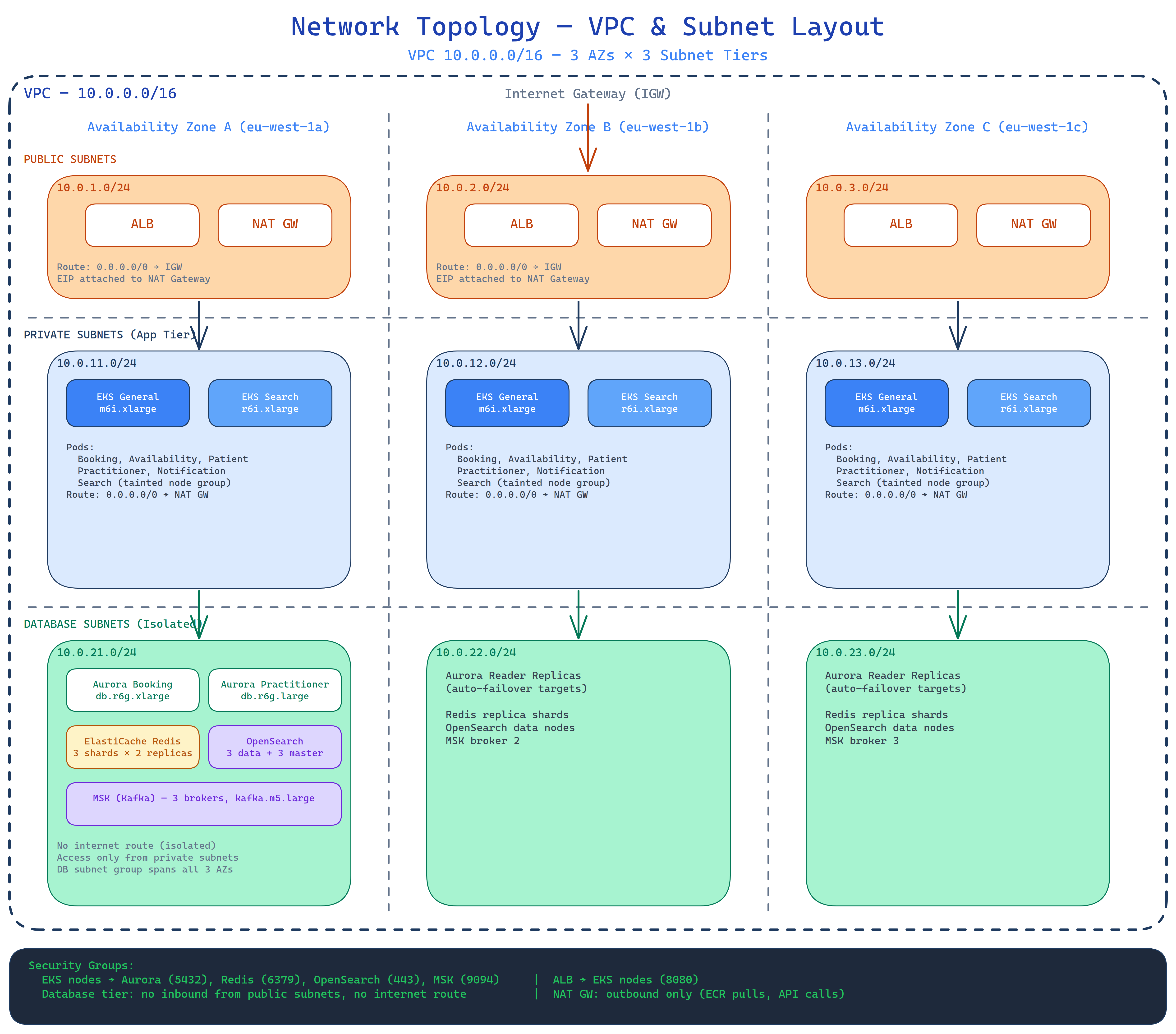
VPC Layout
- 3 Availability Zones, 9 subnets total (3 per AZ tier)
- CIDR blocks carved from the VPC CIDR using
/4increments, allocated by thenetworkingmodule viacidrsubnet - VPC endpoints for S3, ECR, and CloudWatch — traffic to these services stays on the AWS backbone
| Tier | Subnets | Contents |
|---|---|---|
| Public (3) | One per AZ | ALB, NAT Gateways (one per AZ for AZ-local egress), Internet Gateway |
| Private (3) | One per AZ | EKS worker nodes, ElastiCache, OpenSearch, MSK brokers |
| Database (3) | One per AZ | RDS Aurora clusters only; route through private NAT |
Compute — Amazon EKS
Terraform module: terraform/modules/eks/
All six services run as Kubernetes Deployments on EKS with managed node groups.
| Node Group | Instance | Taint | Workloads |
|---|---|---|---|
general |
m6i.xlarge |
None | Booking, Availability, Patient, Practitioner, Notification |
search |
r6i.xlarge |
workload=search:NoSchedule |
Search Service only |
The search node group uses memory-optimised instances because the Search Service holds large OpenSearch client caches. The NoSchedule taint prevents general workloads from landing there; the Search Service values-search.yaml adds the matching toleration and nodeSelector.
EKS control plane logging is enabled for all log types: api, audit, authenticator, controllerManager, scheduler.
An OIDC provider is provisioned alongside the cluster to support IRSA. Each service's ServiceAccount is annotated with its dedicated IAM role ARN, granting least-privilege AWS API access without node-level credentials.
Database — Amazon RDS Aurora PostgreSQL
Terraform module: terraform/modules/rds/
Three independent Aurora clusters, one per domain. The Availability Service shares the practitioner cluster for its schedule/exception data.
| Cluster | Writer | Reader Replicas | Tables |
|---|---|---|---|
booking |
db.r6g.xlarge |
1 | bookings |
practitioner |
db.r6g.large |
1 | practitioners, schedules, exceptions |
patient |
db.r6g.large |
1 | patients |
Common configuration across all clusters:
- Aurora PostgreSQL engine
- Storage encryption enabled
- Deletion protection enabled
- Automated backups — 7-day retention, daily backup window 03:00–04:00 UTC
- Master credentials managed by AWS Secrets Manager with automatic rotation
- Tables partitioned by
country_codefor multi-country isolation
Cache — Amazon ElastiCache (Redis)
Terraform module: terraform/modules/elasticache/
| Setting | Value |
|---|---|
| Mode | Cluster mode enabled |
| Shards | 3 |
| Replicas per shard | 2 |
| Instance type | cache.r6g.xlarge |
| Failover | Multi-AZ with automatic failover |
| Encryption | At rest and in transit |
| Snapshot retention | 3 days (daily window 04:00–05:00 UTC) |
Use cases:
- Availability bitmaps — 24-bit integer per practitioner per day (7M keys ≈ 2–4 GB)
- Search result caching — TTL 30–60 seconds
- Booking slot pre-checks — reduces RDS contention under load
Search — Amazon OpenSearch
Terraform module: terraform/modules/opensearch/
| Setting | Value |
|---|---|
| Data nodes | 3 × r6g.xlarge.search with 100 GB EBS each |
| Master nodes | Dedicated (managed by AWS) |
| Indices | Per-country (practitioners_fr, practitioners_de, …) |
| Access control | Fine-grained; EKS pods authenticate via SigV4 through IRSA |
| Ingestion | Kafka consumer (availability-events, practitioner-events) |
Replica shards on each index allow read scaling without a separate replica cluster. If a data node is lost, replica shards are promoted and the cluster self-heals.
Event Bus — Amazon MSK (Managed Kafka)
Terraform module: terraform/modules/msk/
| Setting | Value |
|---|---|
| Brokers | 3 × kafka.m5.xlarge across 3 AZs |
| Replication factor | 3 |
| Min in-sync replicas | 2 |
| Partitions per topic | 6 (default) |
| Partitioning key | practitioner_id |
| Retention | 7 days / 168 hours |
| Encryption | TLS client-to-broker and in-cluster |
| Auto topic creation | Disabled — topics provisioned explicitly via Terraform |
| Broker logs | Shipped to CloudWatch (/aws/msk/{project}, 14-day retention) |
Topics: booking-events, practitioner-events, availability-events
Notifications — SES + SNS
Terraform module: terraform/modules/notifications/
- Amazon SES — transactional email (confirmations, reminders, cancellations). Domain identity configured and verified via Terraform.
- Amazon SNS — SMS and mobile push notifications.
The Notification Service is the sole producer to SES and SNS. It has an IRSA role scoped to only the ses:SendEmail and sns:Publish actions.
Tagging Strategy
All resources receive the following default tags via the AWS provider default_tags block:
| Tag | Value |
|---|---|
Project |
appointment-system (from var.project) |
Environment |
production |
ManagedBy |
terraform |